Peer Reviewed Sources on the Major Components of the World Wide Web
The World Wide Spider web: Past, Present and Hereafter
Tim Berners-Lee
August 1996
The author is the Director of the World Broad Web Consortium and a principal inquiry scientist at the �Laboratory for Estimator Science, Massachusetts Institute of Technology, 545 Technology Square, Cambridge MA 02139 U.s.A. http://www.w3.org
Draft response to invitation to publish in IEEE Computer special issue of Oct 1996. The special result was I think afterwards abased.
Abstract
The Globe Wide Web was designed originally as an interactive globe of shared information through which people could communicate with each other and with machines. Since its inception in 1989 it has grown initially as a medium for the broadcast of read-only material from heavily loaded corporate servers to the mass of Internet connected consumers. Recent commercial interest its apply within the arrangement under the "Intranet" buzzword takes it into the domain of smaller, airtight, groups, in which greater trust allows more interaction. In the future we look toward the web becoming a tool for fifty-fifty smaller groups, families, and personal information systems. Other interesting developments would be the increasingly interactive nature of the interface to the user, and the increasing use of machine-readable information with defined semantics assuasive more avant-garde auto processing of global data, including auto-readable signed assertions.
Introduction
This newspaper represents the personal views of the author, not those of the World Wide Web Consortium members, nor of host institutes.
This paper gives an overview of the history, the current state, and possible future directions for the World Wide Web. The Spider web is simply divers equally the universe of global network-accessible information. It is an abstract space with which people can interact, and�is currently chiefly populated past interlinked pages of text, images and animations, with occasional sounds, iii dimensional worlds, and videos. Its existence marks the end of an era of frustrating and debilitating incompatibilities between computer systems. The explosion of advisability and the potential social and economical impact has not passed unnoticed past a much larger community than has previously used computers. The commercial potential in the system has driven a rapid pace of development of new features, making the maintenance of the global interoperability which the Web brought a continuous task for all concerned. At the same time, it highlights a number of research areas whose solutions will get more than and more pressing, which we will merely exist able to mention in passing in this paper. Permit us start, though, as promised, with a mention of the original goals of the project, conceived equally information technology was as an answer to the writer's personal need, and the perceived needs of the arrangement and larger communities of scientists and engineers, and the world in general.
History
Before the spider web
The origins of the ideas on hypertext tin be traced back to historic work such as Vanevar Bush's famous commodity "Equally Nosotros May Call up" in Atlantic monthly in 1945 in which he proposed the "Memex" auto which would by a procedure of binary coding, photocells and instant photography, allow microfilms cross-references to be made and automatically followed. It continues with Doug Englebart'due south "NLS"�system which used digital computers and provided hypertext e-mail and documentation sharing, with Ted Nelson's coining of the give-and-take "hypertext". For all these visions, the real world in which the technologically rich field of High Free energy Physics establish itself in 1980 was one of incompatible networks, deejay formats, data formats, and graphic symbol encoding schemes, which made whatsoever attempt to transfer information between dislike systems a daunting and generally impractical chore. This was particularly frustrating given that to a greater and greater extent computers were being used directly for most data handling, and then almost annihilation one might desire to know was almost certainly recorded magnetically somewhere.
Design Criteria
The goal of the Web was to be a shared information space through which people (and machines)�could communicate.
The intent was that this infinite should span from a private information organisation to a public information, from high value carefully checked and designed fabric, to off-the-cuff ideas which brand sense only to a few people and may never be read again.
The design of the globe-broad spider web was based on a few criteria.
- An information organization must be able to record random associations betwixt any capricious objects, unlike most database systems;
- If two sets of users started to use the system independently, to make a link from one arrangement to another should exist an incremental effort, non requiring unscalable operations such as the merging of link databases.
- Any effort to constrain users as a whole to the use of particular languages or operating systems was ever doomed to failure;
- Information must exist available on all platforms, including future ones;
- Any attempt to constrain the mental model users have of data into a given pattern was always doomed to failure;
- If information within an organization is to be accurately represented in the system, entering or correcting it must exist footling for the person straight knowledgeable.
The author'south experience had been with a number of proprietary systems, systems designed past physicists, and with his own Enquire�program (1980)�which allowed random links, and had been personally useful, just had not been usable across a wide area network.
Finally, a goal of the Web was that, if the interaction between person and hypertext could exist and so intuitive that the machine-readable data space gave an accurate representation of the state of people's thoughts, interactions, and work patterns, then machine analysis could go a very powerful management tool, seeing patters in our work and facilitating our working together through the typical issues which beset the management of large organizations.
Basic Architectural Principles
The Www architecture was proposed in 1989 and is illustrated in the figure. It was designed to meet the criteria higher up, and according to well-known principles of software pattern adapted to the network situation.
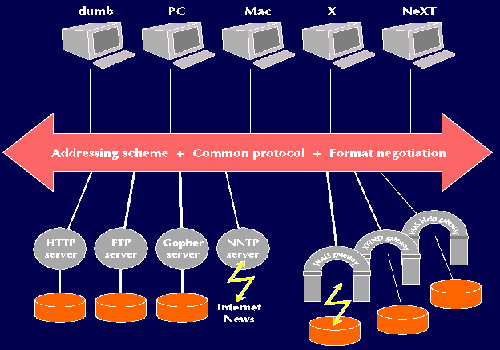
Fig: Original WWW compages diagram from 1990. �The pink arrow shows the common standards: URL, and HTTP, with format negotiation of the data blazon.
Independence of specifications
Flexibility was clearly a fundamental point. Every specification needed to ensure interoperability placed constraints on the implementation and use of the Web. Therefore, as few things should be specified as possible (minimal constraint) and those specifications which had to be made should exist made independent (modularity and information hiding). The independence of specifications would allow parts of the pattern to be replaced while preserving the basic compages. A test of this ability was to supercede them with older specifications, and demonstrate the ability to intermix those with the new. Thus, the old FTP�protocol could exist intermixed with the new HTTP�protocol in the address infinite, and conventional text documents could be intermixed with new hypertext documents.
It is worth pointing out that this principle of minimal constraint was a major factor in the web'southward adoption. �At any point, people needed to make pocket-sized and incremental changes to adopt the spider web, start as a parallel applied science to existing systems, so as the principle one. �The ability to evolve from the past to the present within the general principles of architecture gives some hope that evolution into the time to come will be equally smooth and incremental.
Universal Resource Identifiers
Hypertext every bit a concept had been around for a long time. Typically, though, hypertext systems were congenital around a database of links. This did not scale in the sense of the requirements above. Notwithstanding, it did guarantee that links would be consequent, and links to documents would be removed when documents were removed. The removal of this feature was the principle compromise made in the W3 compages, which then, by assuasive references to be made without consultation with the destination, allowed the scalability which the later on growth of the spider web exploited.
The power of a link in the Web is that information technology tin can bespeak to any document (or, more than mostly, resources) of any kind in the universe of information. This requires a global space of identifiers. These Universal Resources Identifiers are the primary element of Web architecture. The now well-known construction starts with a prefix such equally "http:" to bespeak into which infinite the rest of the string points. The URI�space is universal in that any new space of any kind which has some kind of identifying, naming or addressing syntax can be mapped into a printable syntax and given a prefix, and tin can then become part of URI�space. The properties of whatsoever given URI depend on the properties of the infinite into which information technology points. Depending on these properties, some spaces tend to be known equally "name"�spaces, and some as "address" spaces, but the actual backdrop of a space depend not only on its definition, syntax and support protocols, but also on the social structure supporting information technology and defining the allocation and reallocation of identifiers. The web architecture, fortunately, does not depend on the decision equally to whether a URI�is a proper name or and accost, although the phrase URL (locator)�was coined in IETF�circles to point that most URIs really in use were considered more like addresses than names. We await the definition of more than powerful proper noun spaces, just note that this is not a piffling problem.
Opaqueness of identifiers
An of import principle is that URIs are generally treated every bit opaque strings: customer software is non allowed to look inside them and to describe conclusions most the object referenced.
Generic URIs
Another interesting characteristic of URIs is that they tin identify objects (such every bit documents) generically: One URI tin be given, for instance, for a book, which is available in several languages and several data formats. Another URI�could exist given for the same book in a specific language, and another URI could exist given for a bit stream representing a specific edition of the book in a given language and data format. Thus the concept of "identity" of an Web object allows for genericity, which is unusual in object-oriented systems.
HTTP
As protocols went for accessing remote data, a standard did exist in the File Transfer Protocol (FTP). However, this was not optimal for the web, in that it was as well slow and not sufficiently rich in features, so a new protocol designed to operate with the speed necessary for traversing hypertext links, HyperText Transfer Protocol, was designed. The HTTP�URIs are resolved into the addressed certificate by splitting them into two halves. The first one-half is applied to the Domain Proper noun Service [ref] to discover a suitable server, and the second half is an opaque string which is handed to that server.
A feature of HTTP�is that it allows a client to specify preferences in terms of language and data format. This allows a server to select a suitable specific object when the URI�requested was generic. This feature is implemented in various HTTP�servers but tends to be underutilized past clients, partly because of the time overhead in transmitting the preferences, and partly because historically generic URIs have been the exception. This feature, known equally format negotiation, is one key element of independence between the HTTP�specification and the HTML�specification.
HTML
For the interchange of hypertext, the Hypertext Markup Linguistic communication was divers as a data format to be transmitted over the write. Given the presumed difficulty of encouraging the world to use a new global data system, HTML�was called to resemble some SGML-based systems in social club to encourage its adoption past the documentation community, among whom SGML�was a preferred syntax, and the hypertext customs, amid whom SGML was the only syntax considered as a possible standard. Though adoption of SGML�did let these communities to have the Spider web more than easily, SGML�turned out to take very complex and not very well defined syntax, and the endeavor to observe a compromise between full SGML�compatibility and ease of utilize of HTML bedeviled the experts for a long time.
Early on History
The road from conception to adoption of an idea is frequently tortuous, and for the Web it certainly had its curves. Information technology was clearly impossible to convince anyone to employ the system as it was, having a small audience and content just about itself. Some of the steps were as follows.
- The initial prototype was written in NeXTStep (October-December 1990). This allowed the uncomplicated addition of new links and new documents, equally a "wysiwyg" editor which browsed at the same fourth dimension. However, the limited deployment of NeXStep express its visibility. The initial Web describing the Web was written using this tool, with links to sound and graphic files, and was published by a simple HTTP server.
- To ensure global acceptance, a "line way" browser was written by Nicola Pellow, a very portable hypertext browser which allows web information to be retrieved on any platform. This was all many people at the fourth dimension saw of the Web. (1991)
- In order to seed the Web with data, a second server was written which provided a gateway into a "legacy" phonebook database on a mainframe at CERN. This was the get-go "useful" Web application, and so many people at that point saw the web as a phone book program with a foreign user interface. Even so, it got the line manner browser onto a few desks. This gateway server was followed past a number of others, making a web client a useful tool within the Physics community at least.
- No farther resources being available at CERN, the Internet community �at big was encouraged to port the WorldWideWeb program�to other platforms. "Erwise", "Midas", "Viola-WWW" for X windows and "Cello"�for Windows(tm) were various resulting clients which unfortunately were just browsers, though Viola-WWW, by Pei Wei, was interestingly based on an interpreted mobile lawmaking linguistic communication (Viola) and comparable in some respects to the later Hot Java(TM)
- The Net Gopher was seen for a long time equally a preferable information organisation, avoiding the complexities of HTML, only rumors of the technology beingness licensable provoked a general re-evaluation.
- In 1993, Marc Andreessen of the National Eye for Supercomputing Applications, having seen ViolaWWW, wrote "Mosaic", a World wide web customer for X. Mosaic was like shooting fish in a barrel to install, and later allowed inline images, and became very popular.
- In 1994, Navisoft Inc created a browser/editor more than reminiscent of the original WorldWideWeb programme, existence able to browse and edit in the same mode. [This is currently known as "AOLPress"].
An early metric of spider web growth was the load on the first spider web server info.cern.ch (originally running on the aforementioned machine as the first client, now replaced past www.w3.org). Curiously, this grew as a steady exponential every bit the graph (on a log scale) shows, at a factor of ten per twelvemonth, over 3 years. Thus the growth was conspicuously an explosion, though one could not put a finger on any particular date every bit being more significant than others.
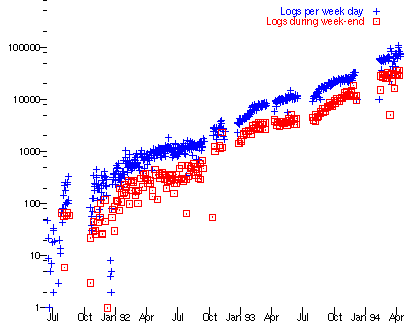
Effigy. Web client growth from July 1991 to July 1994. Missing points are lost data. Fifty-fifty the ratio betwixt weekend and weekday growth remained remarkably steady.
That server included suggestions on finding and running clients and servers. It included a page on Etiquette, which included such conventions as the email accost "webmaster" as a bespeak of contact for queries about a server, the fact that the URL�consisting only of the name of the server should be a default entry point, no matter what the topology of a server's internal links.
This takes development to the betoken where the full general public became aware of information technology, and the rest is well documented. HTML, which was intended to be the warp and weft of a hypertext tapestry crammed with rich and varied data types, became surprisingly ubiquitous. Rather than relying on the extent of computer availability and Internet connectivity, the Spider web started to drive it. The URL syntax of the "http:" blazon became equally self-describing to the public every bit 800 numbers.
Current situation
Now nosotros summarize the current state of web deployment, and some of the recent developments.
Incompatibilities and tensions
The common standards of URIs, HTTP�and HTML�have immune growth of the web, and have also allowed the development resources of companies and universities across the world to be applied to the exploitation and extension of the web. This has resulted in a mass of new data types and protocols.
In the case of new data formats, the ability of HTTP to handle arbitrary data formats has immune piece of cake expansion, so the introduction, for instance, of iii dimension scene description language "VRML", or the Coffee(tm) byte lawmaking format for the transfer of mobile programme code, has been like shooting fish in a barrel. What has been less easy has been for servers to know what clients have supported, as the format negotiation arrangement has not been widely deployed in clients. This has lead, for example, to the distressing engineering practice, in the server, of checking the browser make and version confronting a table kept by the server. This makes it difficult to innovate new clients, and is of course very difficult to maintain. Information technology has lead to the "spoofing"�of well-known clients by new less well known ones on guild to extract sufficiently rich data from servers. This has been accompanied by an insufficiency in the MIME types used to describe data: text/html is used to refer to many levels of HTML; prototype/png is used to refer to any PNG�format graphic, when it is interesting to know how many colors information technology encodes; Java(tm)�files are shipped around without whatsoever visible indication of the runtime back up they will crave to execute.
Forces toward compatibility and progress
Throughout the industry, from 1992 on, there was a strong worry that a fragmentation of the Web standards would somewhen destroy the universe of information upon which so many developments, technical and commercial, were being built. This lead to the formation in 1994 of the Globe Wide Web Consortium. At the time of writing, the Consortium has effectually 150 members including all the major developers of Web technology, and many others whose businesses are increasingly based on the ubiquity and functionality of the Spider web. Based at the Massachusetts Institute of Applied science in the Us and at the Institute Nationale pour la R�cherche en Informatique et Automatique in Europe, the Consortium provides a vendor-neutral forum where competing companies can meet to agree on common specifications �for the common good. The Consortium'due south mission, taken broadly, is to realize the full potential of the Web, and the directions in which this is interpreted are described later on.
From Protecting Minors�to Ensuring Quality: PICS
Of the developments to web protocols are driven sometimes by technical needs of the infrastructure, such as those of efficient caching, sometimes by particular applications, and sometimes by the connection between the Web and the guild which can be congenital around it. Sometimes these become interleaved. An case of the latter was the need to address worries of parents, schools, and governments that young children would gain admission to cloth which though indecency, violence or other reason, was judged harmful to them. Under threat of authorities restrictions of internet utilize, or worse, regime censorship, the community reacted speedily in the grade of W3C'southward Platform for Cyberspace Content Selection (PICS)�initiative. PICS introduces new protocol elements and data formats to the web architecture, and is interesting in that the principles involved may apply to futurity developments.
Substantially, PICS allows parents to set up upward filters for their children's data intake, where the filters can refer to the parent's option of independent rating services. Philosophically, this allows parents (rather than centralized government)�to define what is also "indecent" for their children. Information technology is, similar the Internet and the Web, a decentralized solution.
Technically, PICS involves a specification for a machine readable "label". Unlike HTML, PICS labels are designed to be read past machine, by the filter software. They are sets of attribute-value pairs, and are self-describing in that any label carries a URL�which, when dereferenced, provides both machine-readable and human-readable explanations of the semantics of the attributes and their possible values.
Figure: The RSAC-i rating scheme. An example of a PICS scheme.
PICS labels may exist obtained in a number of means. They may be transported on CD-ROM, or they may be sent by a server along with labeled information. (PICS labels may be digitally signed, so that their authenticity tin be verified independently of their method of delivery). They may also be obtained in real time from a third party. This required a specification for a protocol for a party A to inquire a party B for whatsoever labels which refer to data originated by party C.
Conspicuously, this technology, which is expected soon to be well deployed under pressure about communications decency, is hands applied to many other uses. The label querying protocol is the aforementioned as an annotation retrieval protocol. Once deployed, information technology volition let label servers to nowadays annotations also equally normal PICS labels. PICS labels may of course exist used for many different things. Fabric volition be able to exist rated for quality for adult or scholarly utilize, forming "Seals of Approving" and assuasive individuals to select their reading, ownership, etc, wisely.
Security and Ecommerce
If the world works by the substitution of information and money, the web allows the substitution of information, and and then the interchange of coin is a natural next step. In fact, exchanging greenbacks in the sense of unforgeable tokens is impossible digitally, only many schemes which cryptographically or otherwise provide assurances of promises to pay let check book, credit card, and a host of new forms of payment scheme to be implemented. This article does not have space for a discussion of these schemes, nor of the various means proposed to implement security on the spider web. �The ability of cryptography to ensure confidentiality, authentication, non-repudiation, and message integrity is not new. The current situation is that a number of proposals exist for specific protocols for security, and for payment a adequately large and growing number of protocols and research ideas are around. One protocol, Netscape'southward "Secure Socket Layer", which gives confidentiality of a session, is well deployed. For the sake of progress, the W3 Consortium is working on protocols to negotiate the security and payment protocols which volition exist used.
Machine interaction with the web
To date, the principle motorcar assay of cloth on the web has been its textual indexing by search engines. �Search engines have proven remarkably useful, in that big indexes tin be searched very rapidly, and obscure documents found. �They accept proved to be remarkably useless, in that their searches generally take merely vocabulary of documents into account, and have little or no concept of document quality, so produce a lot of junk. Below we discuss how calculation documents with defined semantics to the spider web should enable much more powerful tools.
Some promising new ideas involve analysis not merely of the web, but of people's interaction with it, to automatically reap more idea of quality and relevance. Some of these programs, sophisticated search tools, take been described every bit "agents" (considering they act on behalf of the user), though the term is unremarkably used for programs that are actually mobile. �There is currently piddling by and large deployed use of mobile agents. �Mobile code is used to create interesting human interfaces for information (such equally Java "applets"), and to bootstrap the user into a new distributed applications. �Potentially, mobile code�has a much greater bear upon on the software architecture of software on client and server machines. Withal, without a spider web of trust to allow mobile programs (or indeed fixed web-searching programs) to act on a use's behalf, progress volition be very limited.�
Time to come directions
Having summarized the origins of the Web, and its current state, nosotros now look at some possible directions in which developments could have it in the coming years. One can separate these into�three long term goals. The first involves the improvement of the infrastructure, to provide a more functional, robust, efficient and bachelor service. The second is to enhance the spider web as a ways of communication and interaction between people. The 3rd is to allow the web, autonomously grade being a space browseable past humans, to contain rich data in a form understandable past machines, thus assuasive machines to take a stronger role in analyzing the spider web, and solving problems for us.
Infrastructure
When the web was designed, the fact that anyone could beginning a server, and it could run happily on the Internet without regard to registration with whatever cardinal authority or with the number of other HTTP�servers which others might be running was seen equally a key property, which enabled it to "scale". Today, such scaling is not enough. The numbers of clients is so great that the need is for a server to be able to operate more or less independently of the number of clients. The are cases when the readership of documents is then cracking that the load on severs becomes quite unacceptable.
Further, for the spider web to be a useful mirror of existent life, it must exist possible for the emphasis on various documents to alter rapidly and dramatically. If a popular newscast refers by chance to the work of a item schoolchild on the spider web, the schoolhouse cannot be expected to have the resource to serve copies of it to all the of a sudden interested parties.
Another cause for evolution is the fact that business is at present relying on the Spider web to the extend that outages of servers or network are not considered acceptable. An architecture is required allowing error tolerance. Both these needs are addressed by the automatic, and sometimes preemptive, replication of data. At the same time, one would not wish to see an exacerbation of the situation suffered past Usenet News administrators who accept to manually configure the disk and caching times for dissimilar classes of data. Ane would prefer an adaptive system which would configure itself so as to all-time utilize the resources bachelor to the various communities to optimize the quality of service perceived. This is not a simple problem. It includes the bug of
- categorizing documents and users so equally to be able to treat them in groups;
- anticipating high usage of groups of documents past groups of users;
- deciding on optimal placement of copies of information for rapid access;
- an algorithm for finding the cheapest or nearest copy, given a URL;
Resolution of these problems must occur within a context in which different areas of the infrastructure are funded through different bodies with different priorities and policies.
These are some of the long term concerns about the infrastructure, the basic compages of the web. In the shorter term, protocol designers are increasing the efficiency of HTTP communication, particularly for the case of a user whose functioning limiting particular is a phone modem.
Man Advice
In the short term, work at W3C and elsewhere on improving the web as a communications medium has mainly centered around the information formats for various displayable document types: continued extensions to HTML, the new Portable Network Graphics (PNG)�specification, the Virtual Reality Markup Language (VRML), etc. Presumably this will proceed, and though HTML will be considered part of the established infrastructure (rather than an exciting new toy), there volition e'er exist new formats coming forth, and it may be that a more than powerful and peradventure a more consistent fix of formats will eventually readapt HTML. In the longer term, there are other changes to the Spider web which will be necessary for its potential for man communication to be realized.
Nosotros have seen that the Web initially was designed to be a space within which people could work on an expression of their shared knowledge. This was seen every bit being a powerful tool, in that
- when people combine to build a hypertext of their shared understanding, they have it at all times to refer to, to allay misunderstandings of one-fourth dimension letters.
- when new people join a team, they accept all the legacy of decisions and hopefully reasons available for their inspection;
- when people leave a squad, their work is captured and integrated already, a "debriefing"�non being necessary;
- with all the workings of a project on the spider web, auto analysis of the organization becomes very enticing, peradventure allowing us to draw conclusions about management and reorganization which an private person would find hard to elucidate;
The intention was that the Web should be used as a personal information arrangement, as a group tool at all scales from the team of two, to the world population deciding on ecological issues. An essential power of the system, as mentioned higher up, was the ability to motion and link information between these layers, bringing the links betwixt them into articulate focus, and helping maintain consistency when the layers are blurred.
At the time of writing, the most famous aspect of the web is the corporate site which addresses the general consumer population. Increasingly, the power of the spider web within an arrangement is existence appreciated, nether the buzzword of the "Intranet". Information technology is of grade by definition difficult to guess the amount of cloth on individual parts of the spider web. However, when in that location were only a few hundred public servers in being, 1 large reckoner company had over a hundred internal servers. Although to gear up a private server needs some attending to access command, once it is done its use is accelerated by the fact that the participants share a level of trust, by being already function of a visitor of grouping. This encourages information sharing at a more spontaneous and direct level than the publication rituals of passage advisable for public fabric.
A contempo workshop shed light on a number of areas in which the Web protocols could exist improved to assist collaborative use:
- Amend editors to allow direct interaction with web data;
- Notificaton of those interested when information has changed;
- Integration of audio and video internet conferencing technologies
- Hypertext links which represent in a visible and analyzable way the semantics of human processes such as argument, peer review, and workflow management;
- Third party annotation servers;
- Verifiable hallmark, allowing grouping membership to be established for access command;
- The representation of links as first class objects with version control, authorship and ownership;
amongst others.
At the microcosmic end of the scale, the web should be naturally usable as a personal data organisation. Indeed, it will not exist natural to employ the Web until global information and personal information are handled in a consistent way. From the homo interface point of view, this means that the bones computer interface which typically uses a "desktop" metaphor must be integrated with hypertext. It is not as though at that place are many big differences: file systems have links ("aliases", "shortcuts") just like spider web documents. Useful information management objects such as folders and nested lists volition need to be transferable in standard ways to exist on the spider web. The writer also feels that the importance of the filename in computer systems will subtract until the ubiquitous filename dialog box disappears. What is important nearly data can all-time exist stated in its title and the links which be in various forms, such as enclosure of a file inside a folder, advent of an email accost in a "To:" field of a message, the relationship of a document to its writer, etc. These semantically rich assertions brand sense to a person. If the user specifies essential data such as the availability and reliability levels required of access to a document, and the domain of visibility of a document, then that leaves the organization to manage the niceties of deejay infinite in such a way equally to requite the required quality of service.
The end result, 1 would promise, will be a consistent and intuitive universe of data, some part of which what one sees whenever one sees a reckoner screen, whether information technology be a pocket screen, a living room screen, or an auditorium screen.
Machine interaction with the web
As mentioned above, an early on only long term goal of the web development was that, if the spider web came to accurately reverberate the noesis and interworkings of teams of people, that machine assay would get a tool enabling us to assay the ways in which nosotros collaborate, and facilitating our working together. �With the growth of commercial applications of the spider web, this extends to the ideal of allowing computers to facilitate business organisation, interim equally agents with power to deed financially.
The showtime significant modify required for this to happen is that data on the spider web which is potentially useful to such a program must be available in a motorcar-readable grade with defined semantics. �This could be done along the lines of the Electronic Certificate Interchange (EDI) [ref], in which a number of forms such as offers for sale, bills of sale, title deeds, and invoices are devised as digital equivalents of the paper documents. �In this case, the semantics of each grade is divers by a human readable specification certificate. Alternatively, general purpose languages could be divers in which assertions could exist made, inside which axiomatic concepts could exist defined from fourth dimension to time in human being readable documents. �In this instance, the ability of the language to combine concepts originating from different areas could lead to a very much more powerful organisation on which one could base machine reasoning systems. �Cognition Representation (KR) languages are something which, while interesting academically, accept not had a broad impact on applications of computer. � But and then, the same was true of hypertext before the Spider web gave information technology global scope.
At that place is a bi-directional connection between developments in automobile processing of global data and in cryptographic security. �For automobile reasoning over a global domain to exist constructive, machines must be able to verify the actuality of assertions found on the spider web: this requires a global security infrastructure allowing signed documents. �Similarly, a global security infrastructure seems to need the ability to include, in the information about cryptographic keys and trust, the manipulation of fairly complex assertions. �It is perhaps the craven-and-egg interdependence which has, along with government restrictions on the utilize of cryptography,�delayed the deployment of either kind of system to date.
The PICS system may be a first step in this direction, as its labels are machine readable.
Ethical and social concerns
At the first International World wide web Conference in Geneva in May 1994, the author made a closing comment that, rather than being a purely academic or technical field, the engineers would find that many upstanding and social issues were being addressed past the kinds of protocol they designed, then that they should not consider those issues to be somebody else'due south problem. In the short time since then, such issues have appeared with increasing frequency. �The PICS initiative showed that the form of network protocols can affect the course of a society which one builds within the information space.
Now nosotros have concerns over privacy. Is the right to a really individual conversation one which we enjoy just in the heart of a big open up space, or should nosotros requite it to individuals connected across the network? �Concepts of intellectual property, central to our culture, are not expressed in a way which maps onto the abstract data space. In an information space, nosotros can consider the authorship of materials, and their perception; simply we take seen in a higher place how there is a demand for the underlying infrastructure to exist able to make copies of data just for reasons of efficiency and reliability. The concept of "copyright" equally expressed in terms of copies made makes little sense. Furthermore, once those copies have been made, automatically by the system, this gives the possibility them being seized, and a conversation considered individual beingness later exposed. Indeed, it is difficult to list all the ways in which privacy can be compromised, equally operations which were previously manual can be done in bulk extremely easily. �How can content providers get feedback out the demographic make-up of those browsing their material, without compromising individual privacy? �Though irksome in small quantities, the questions individuals ask of search engines, in bulk, could exist compromising data.�
In the long term, there are questions every bit to what will happen to our cultures when geography becomes weakened as a diversifying force? Will the internet lead to a monolithic (American) culture, or will it foster even more disparate interest groups than exist today? Volition information technology enable a true commonwealth past informing the voting public of the realities behind state decisions, or in practice will it harbor ghettos of bigotry where emotional intensity rather than truth gains the readership?� It is for us to decide, but it is non trivial to assess the impact of simple engineering decisions on the answers to such questions.
Conclusion
The Web, similar the Cyberspace, is designed then as to create the desired "finish to end" effect, whilst hiding to every bit large an extent as possible the intermediate machinery which makes information technology work. �If the law of the country can respect this, and be couched in an "terminate to end" terms, such that no government or other interference in the mechanisms is legal that would break the stop to end rules, then it can go on in that way. �If not, engineers will have to learn the art of designing systems so that the end to end functionality is guaranteed whatever happens in between. �What TCP did for reliable delivery �(providing it finish-to-end when the underlying network itself did not provide it) , cryptography is doing for confidentiality. Farther protocols may do this for information ownership, payment, and other facets of interaction which are currently jump by geography. For the information space to be a powerful place in which to solve the bug of the adjacent generations, its integrity, including its independence of hardware, parcel route, operating system, and application software brand, is essential. �Its properties must be consistent, reliable, and fair, and the laws of our countries will have to work hand in paw with the specifications of network protocols to make that and then.
References
Space is insufficient for a bibliography for a field involving so much work past so many. The World wide web has a dedicated series of conferences run by an independent committee. �For papers on advances and proposals on Web related topics, the reader is directed to past and future conferences. The proceedings of the concluding two conferences to engagement are as below.
Proceedings of the Quaternary International World Wide Spider web Conference (Boston 1995), The World Wide Web Journal, Vol. 1, Iss. 1, O'Reilly, Nov. 1995. ISSN 1085-2301, ISBN: 1-56592-169-0. �[[Later issues may also be of interest.]
Proceedings of the 5th Internatonal Www Briefing, Estimator Networks and ISDN systems, Vol 28 Nos vii-11, Elsevier, May 1996.
Too refered to in the text:
[one] Bush, Vannevar, "Every bit We May Think", Atlantic Monthly, July 1945. �(Reprinted also in the following:)
[2] Nelson, Theodore, Literary Machines 90.ane, Mindful Press, 1990
[three] Englebart, Douglas, Boosting Our Collective IQ - Selected Readings, Boostrap Plant/BLT Printing, 1995, <AUGMENT,133150,>, ISBN:1-895936-01-2
[5] On Gopher, Run across F. Anklesaria, M. McCahill, P. Lindner, D. Johnson, D. John, D. Torrey, B. Alberti, "The Internet Gopher Protocol (a distributed document search and retrieval protocol)", RFC 1436 03/eighteen/1993. , http://ds.internic.net/rfc/rfc1436.txt
[half dozen] On EDI, Run across http://polaris.disa.org/edi/edihome.htp
Source: https://www.w3.org/People/Berners-Lee/1996/ppf.html
0 Response to "Peer Reviewed Sources on the Major Components of the World Wide Web"
Post a Comment